
In most organisations, documents created ten or fifteen years ago are still there, online, indexed and accessible, long after their legal retention period has expired.
The reason is simple: an administrative retention period written down in a retention schedule has never destroyed a single document. To be genuinely enforced, it has to be carried by the platform itself.
This is where GoFAST comes in, industrialising the entire chain: active retention period, automatic pre-archiving, retention expiry, notification of records managers, appraisal workspace and final disposition.
Why retention has to be enforced by the platform
The observation is shared by most public bodies and mid-sized organisations: retention schedules exist, retention periods are documented, but applying them remains a manual task, and therefore only ever partial.
The result: file servers and document management systems that keep accumulating documents whose legal retention period expired years ago. A compliance risk under the storage limitation principle, a legal risk in the event of litigation, and a storage cost that keeps growing with no business justification.
For document lifecycle management to be genuinely applied, it has to be handled by the platform rather than left to users’ discipline. That is the principle behind GoFAST: rules are configured once in the administration interface, then applied automatically across the entire document estate.
Two sequential retention periods: active, then administrative
GoFAST chains two retention periods sequentially rather than in parallel. This mirrors real records management logic: a document only enters its administrative retention period once its active retention period has expired.
| Stage | Trigger | Effect in GoFAST |
|---|---|---|
| Active retention period | Starts or restarts on the document’s last modification | The document stays in active use, editable and collaborative |
| End of active retention | Period expires | Automatic switch to the “pre-archived” state: the document becomes read-only, both in the interface and in the underlying Alfresco DMS |
| Administrative retention period | Starts as soon as the document is pre-archived | The document is retained for administrative and legal purposes, with no possibility of modification |
| End of administrative retention | Period expires | Records managers are notified automatically for appraisal, with the final disposition indicated |
| Final disposition | Records manager’s decision | Transfer to an electronic archiving system for legally admissible preservation, or destruction |
What the platform does today
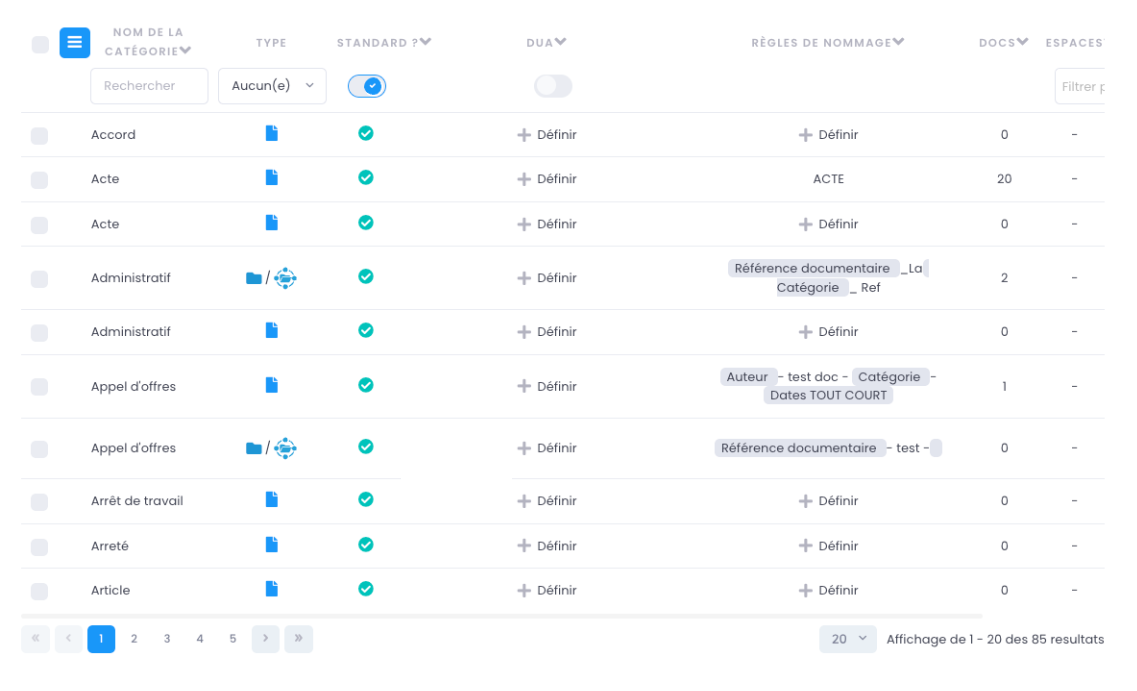
Configuration by document category. Invoice, meeting minutes, quotation, contract... each category carries its own retention period and final disposition, configured in the administration interface by an authorised profile. No individual data entry is required: filing a document is enough to apply its retention rule.
Pre-archiving and locking. Switching to the pre-archived state starts the administrative retention period and freezes the document’s content.
Notification of records managers. On expiry, a predefined list of stakeholders is alerted to check the final disposition and carry out the expected actions.
Explicit final disposition. For appraisal, to be retained or transferred, for destruction.
GoFAST is not an electronic archiving system, and that is deliberate
The distinction is worth stating clearly, as it is a recurring source of confusion in projects. GoFAST handles the document lifecycle up to the final disposition decision: retention periods, pre-archiving, appraisal, audit trail. Legally admissible archiving in the statutory sense is the remit of a dedicated electronic archiving system (SAE).
GoFAST therefore sits upstream of the archiving system, in a two-tier archiving chain. Documents whose final disposition is permanent preservation are identified, tracked and prepared for transfer, together with the corresponding transfer record. Interconnection with the target archiving system is then a project-level matter: it can rely on standard archival exchange formats and on exchange hubs such as Pastell, widely deployed across the French public sector.
Conversely, a document whose final disposition is destruction has no reason to be transferred into an archiving system only to be destroyed there. GoFAST therefore supplies everything needed to draw up the destruction record: list of documents concerned, category, administrative retention expiry date and final disposition, all exportable from the appraisal workspace. The record itself is produced manually by the records manager from that export, automatic generation not being available at this stage. The archival audit trail is maintained without an unnecessary technical detour through an archiving system.
Enhancements co-designed with customers
This roadmap did not come out of a laboratory. It was built with GoFAST customers over two dedicated workshops on retention management, supplemented by regular exchanges and testing sessions, bringing together records managers, CIOs and heads of information governance. Four needs emerged: automating the switch to the pre-archived state, allowing final disposition to be validated in bulk, opening that validation up to business users, and extending the mechanism beyond the individual document.
Extension to folders and collaborative spaces. The same mechanism applies to all three content levels: the document, the folder and the collaborative space. Folders receive their own metadata and are indexed, each level carries its category, its retention period and its final disposition, and switches automatically to pre-archived on expiry. A direct answer to the proliferation of dormant folders and spaces that most CIOs observe.
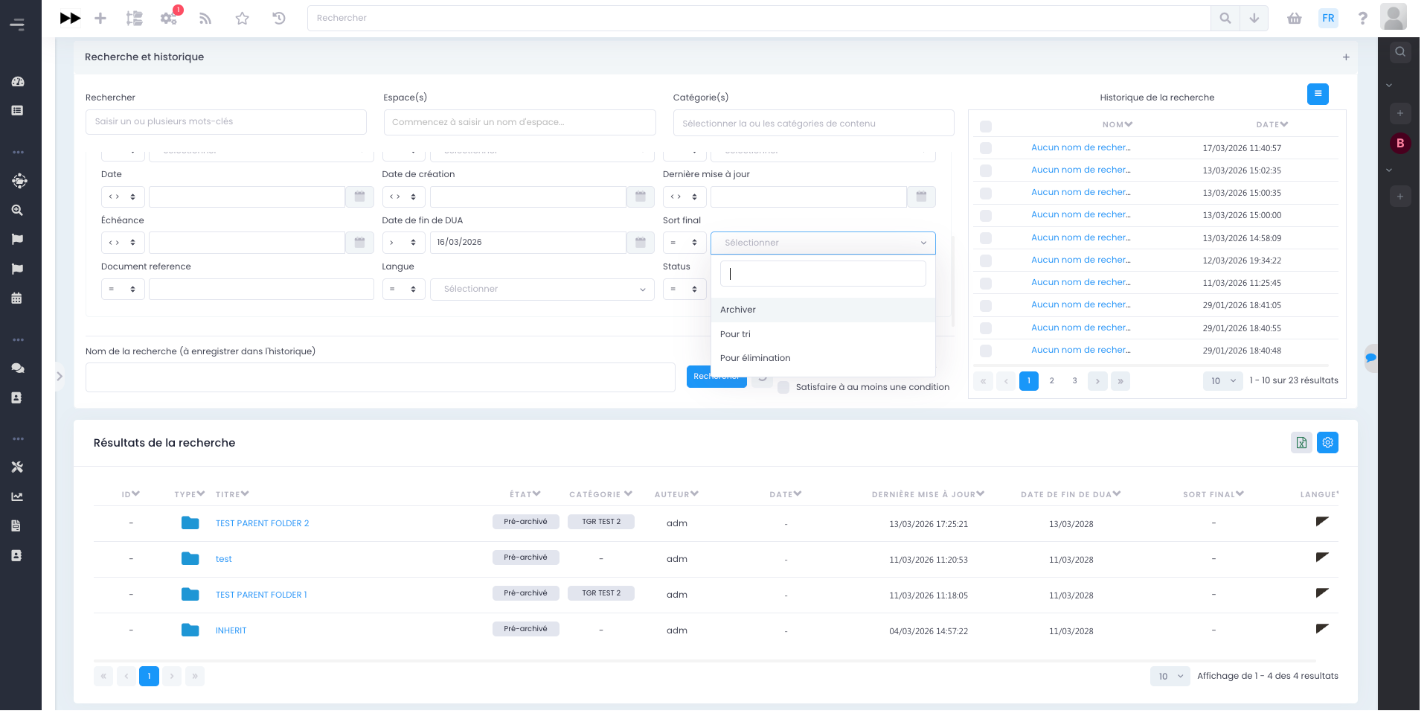
Appraisal workspace within advanced search. Filters on the administrative retention expiry date and on final disposition, sortable columns carried over into the export, multi-selection and bulk actions for destruction or transfer to an archiving system. Records managers finally have a proper workbench rather than a plain list of links.
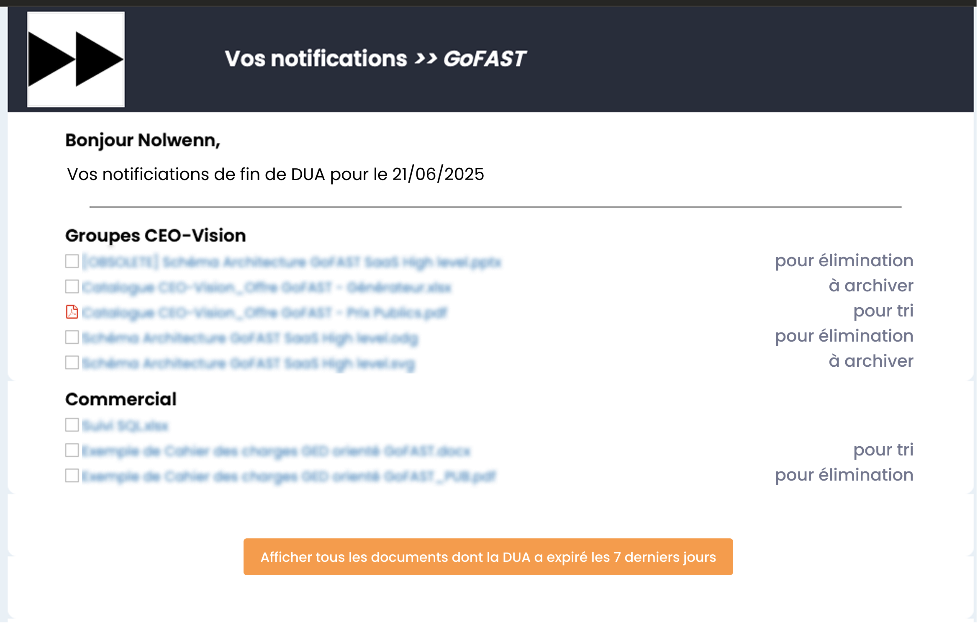
Redesigned notification. Grouping by collaborative space, systematic indication of the final disposition, and a direct link to advanced search pre-filtered on expired retention periods. A configurable sending frequency, up to an annual campaign, is also among the requests expressed by organisations that appraise their records in waves.
ARDP profile. Access rights are an often overlooked issue in archiving projects. GoFAST stays true to its core principle: under no circumstances does any role or profile have access to all the content on the platform. Rather than creating an all-seeing records manager role, the platform relies on a dedicated profile, the ARDP profile, whose access is restricted to documents that have reached or passed their administrative retention expiry date. It is intended for information governance and compliance functions, records managers, DPOs and CISOs, who need to carry out appraisal without gaining access to the live content of collaborative spaces. Appraisal becomes possible without opening a breach in space confidentiality.
What this changes for CIOs, records managers and DPOs
Volume under control. Documents leave the active perimeter once their active retention period has expired, which contains storage growth and the associated costs.
Demonstrable compliance. Retention periods are no longer declarative, they are applied, dated and auditable.
Shared governance. Records managers, DPOs and CISOs share a common working tool, with no exception to confidentiality rules.
Lifecycle management built into the platform. Retention and final disposition are handled natively, with no custom development, and fit into the organisation’s wider archiving strategy.
Conclusion
A retention period is only worth something if it is applied. As long as the rule stays in a retention schedule and its execution depends on users, the document estate keeps growing, and the compliance risk grows with it.
GoFAST moves the rule into the platform: the period runs on its own, the document locks on its own, the records manager is alerted on expiry and has a genuine workbench to carry out appraisal, without anyone gaining blanket access to content. The final disposition decision remains human, legally admissible archiving remains the archiving system’s job, but everything leading up to it is finally automated.
Retention management is part of the core GoFAST feature set, available both On-Premise and as a sovereign dedicated SaaS. The enhancements described here are part of the product roadmap for version 4.6.
Would you like to test your retention schedule against GoFAST document lifecycle management? Contact the GoFAST team for a demonstration.